The Broken Parity Fable by TD Lee
Tsung-Dao Lee and Chen Ning Yang won the Nobel Prize in Physics in 1957, for their work on the violation of the parity law in weak interactions, which Chien-Shiung Wu experimentally proved.
In the article Broken Parity, TD Lee wrote about his relationship with CN Yang, regarding the eventual breakup of their companionship, for the disagreement on who discovered the violation of the parity first. At the very start of that article, there’s an interesting short fable written by Lee about the discovery of the theory. For a long time I couldn’t find the original English version of it, with the arrival of TD Lee’s Selected Papers Volume 3 Random Lattices to Gravity, it’s finally unveiled to me. Here’s the original version of the fable.
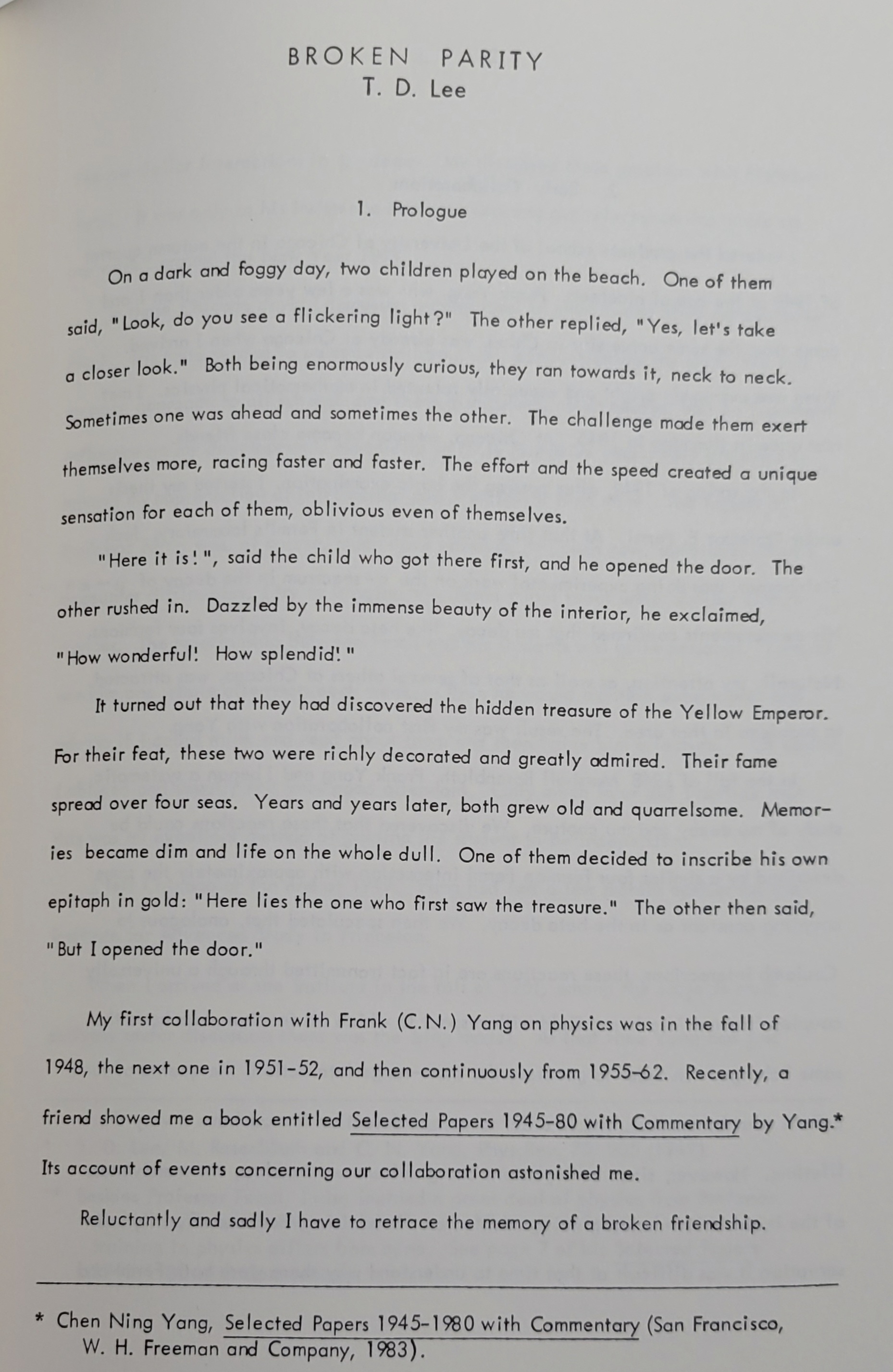
Broken Parity
T.D. Lee
1. Prologue
On a dark and foggy day, two children played on the beach. One of them said, "Look, do you see a flickering light?" The other replied, "Yes, let's take a closer look.' Both being enormously curious, they ran towards it, neck to neck. Sometimes one was ahead and sometimes the other. The challenge made them exert themselves more, racing faster and faster. The effort and the speed created a unique sensation for each of them, oblivious even of themselves.
"Here it is!", said the child who got there first, and he opened the door. The other rushed in. Dazzled by the immense beauty of the interior, he exclaimed, "How wonderful! How splendid!"
It turned out that they had discovered the hidden treasure of the Yellow Emperor. For their feat, these two were richly decorated and greatly admired. Their fame spread over four seas. Years and years later, both grew old and quarrelsome. Memories become dim and life on the whole dull. One of them decided to inscribe his own epitaph in gold: "Here lies the one who first saw the treasure." The other then said, "But I opened the door."
...
Photo of the referenced page
TD Lee passed away on August 4, 2024, just a year before CN Yang. Unlike the latter, Chinese people hardly know about Lee’s passing. This hurts me because he is too a great physicist. I hereby offer my deepest respect to him, and send my condolences to his family.